
♥ → Electrical conduction system of the Heart ← ♥
By BoNbOoNa
Updated 5 min read
Key takeaways
The electrical conduction system of the heart told as a story: basic heart structure and function, the heart's electrical system and its pacemakers.
Once upon a time , . . .
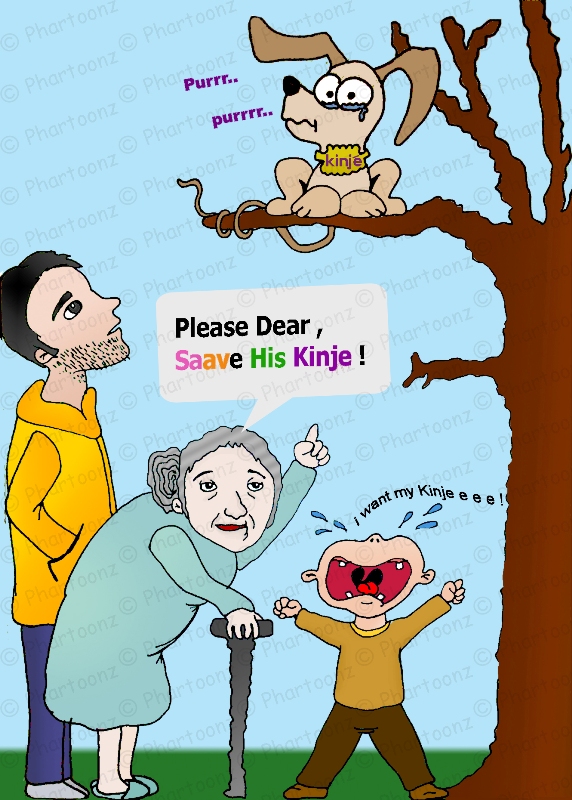
a little boy went with his grandma to the garden and started playing with His dog ” kinje “
while playing .. kinje climbed a tree and couldnt go back down again
he was very scared and shaking : ” Purrr Purrrr ” !!
the little boy started crying .. 
a gentle man was walking near them  .. so , the old lady took the chance & asked him to help her Grand child
and “ Saave His Kinje “
( saave with 2 “a”s because old people’s voice sometimes vibrate while speaking  )
i could continue and turn this post into a bed time story
But this website is concerned with Pharmacology and how to make it memorized in a weird … i mean , easy way !  . . . Not telling bed time stories & fairy tales .
so lets get into some scientific action !
But keep in mind the old lady’s sentence “ Saave His Kinje “
Understanding the Heart Basic Structure & Function :
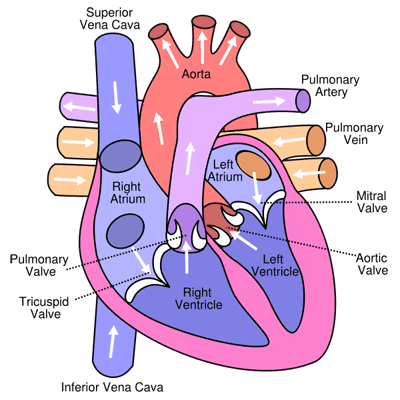
The heart consists of 4 chambers : the left atrium, the left ventricle, the right atrium and the right ventricle.
The heart pumps oxygenated blood (+O2) to the body & de-oxygenated blood (-O2 \ +CO2 ) to the lungs, there is one atrium and one ventricle for each circulation:
– The blood that is returned to the right atrium is de-oxygenated (-O2 \ +CO2 ) and passed into the right ventricle to be pumped through the pulmonary artery to the lungs for re-oxygenation and removal of C02 .
– The left atrium receives newly oxygenated blood from the lungs through the pulmonary vein which is passed into the strong muscular left ventricle to be pumped through the aorta artery to the tissues of the body.
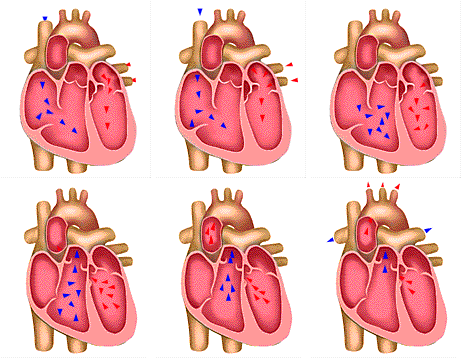
this animation shows an excellent demonstration of the body and lung circulations :
The Heart has its own private circulation to enrich its cells and tissues with blood ,
it’s called the coronary circulation ( circulation No 3 .. calculate 😉 ) :
The vessels that deliver oxygenated blood (+O2) to the myocardium are known as coronary arteries & the vessels that remove the de-oxygenated (-O2 \ + CO2 ) blood from the heart muscle are known as coronary veins.
Blockage or occlusion of one of the coronary arteries causes interruption of blood supply to a part of the heart causing some heart cells to die and can lead to a Heart attack
to get a clear image about what happens in a Heart attack , please watch this medical animation :
Hint :
– Blood and lymph are two fluids that move through the body. The blood, heart, and blood vessels form the cardiovascular system.
– The lymph, lymph nodes, and lymph vessels form the lymphatic system.
Both Systems make up the circulatory system which transports nutrients such as amino acids and electrolytes, gaseous parts, blood cells, waste of nitrogen products, etc. to and from the body to help fight infections and assist to moderate internal temperature and maintain body homeostasis, which are all important for us to survive .

the heart’s electrical system :
an internal electrical system is impeded inside the heart and controls the speed and rhythm of the heartbeat.
With each heartbeat , an electrical signal spreads from the top to the bottom of the heart .
As it travels, the electrical signal causes the heart to contract and pump blood. The process repeats with each new heartbeat.
The heart’s electrical system Cells Possess specific & unique properties :
(1) automaticity: the ability to spontaneously generate and discharge an electrical impulse .
(2) excitability: the ability of the cell to respond to an electrical impulse .
(3) conductivity : the ability to transmit an electrical impulse from one cell to the next .
Electricity generators “ Pacemakers “ :
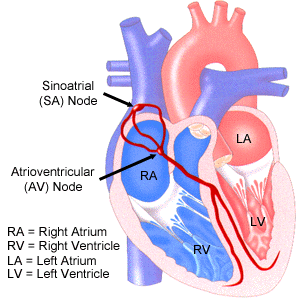
Each electrical signal begins in the sinus node, or sinoatrial “SA” node which is located in the right atrium,.
In a healthy adult heart at rest, the SA node fires off an electrical signal to begin a new heartbeat 60 to 100 times per minute.
After the SA node Shoots , the electrical signal travels through special pathways to the atria causing their contraction and therefore , blood is pumped successfully into the ventricles.
The electrical signal then moves down towards the atrioventricular “AV” node, located between the atria and the ventricles.
Here, the signal slows down just a little bit , giving the ventricles some time to finish getting filled up with blood.
The electrical signal then leaves the AV node and travels along a pathway called the bundle of His which is divided into right & left bundle branches then reaches the Purkinje fibers .
The signal goes down through these fibers to towards the ventricles, causing them to contract and pump blood out to the lungs (R. ventricle) and the rest of the body (L.ventricle) .
The ventricles then relax and the heartbeat process starts all over again in the SA node
Back to our toon now ,
the old lady’s sentence ( do you still remember it :happy: ? ) joins all the Pacemakers of the heart , so you can easily memorize the names and the right sequence also .
Illustration 🙂 :
“ Saave His Kinje “
Sa : Sino-atrial node (SA node )
av : atrio-ventricular node (AV node )
His : Bundle of His
Kinje , + also the frightend voice of the dog “ Purrr ” refers to : Purkinje fibers .
together : the Sa node , Av node , bundle of His & purkinje fibers ensure cardiac muscle contraction in the correct sequence in order to enable blood to be pumped around the body effectively , so you could get the oxygen you need .
for further information about how the cardiac muscles contract , Please watch that animation :
—–
References :
– Netter’s atlas of Human Physiology
– Essentials of Human Physiology for Pharmacy
Tagged
About the author
Keep reading
How to Read ECG basic common Charts
with a good understanding of electrocardiograms (ECGs) , you’ll be able to diagnose a wide range of heart problems, an ECG waveform helps you in monitoring the patients condition and if necessary , begin lifesaving interventions .. To Build up basic ECG skills , you should begin first with an overview of the heart’s anatomy…
Sep 25, 2010
Video – Cardiac conduction system wtih ECG / EKG
A good video that illustrate the conduction system of the heart with relationship to ECG. Here are another articles & videos that are previously posted : http://www.phartoonz.com/2015/07/24/cardiac-conduction-system-ecg-video/ http://www.phartoonz.com/2010/09/10/electrophysiology-phases-of-the-cardiac-cycle/ http://www.phartoonz.com/2010/09/25/how-to-read-ecg-basic-common-charts/ http://www.phartoonz.com/2010/09/02/electrical-conduction-system-of-the-heart/
Dec 19, 2015
Cardiac conduction system – ECG [Video]
It is an amazing work done by Primal Pictures to demonstrate the Cardiac conduction system and the relation with ECG. Moreover, you can read more about How to read ECG basic common charts HERE. Please watch and Re-share if you like it. Cardiac Conduction system illustration: Good luck You can read more about ECG :…
Jul 24, 2015
Conduction system of the Heart & ECG understanding [Video]
An interesting video from Aliliamedicalmedia explaining the conduction system of the heart , you may want to check another tutorial about ECG , Click here
Mar 20, 2015
17 comments
From the original article · comments are closed
small business grants
My cousin recommended this blog and she was totally right keep up the fantastic work!
BoNbOoNa
thank you 🙂 Kindest regards to you & your cousin 😊
BoNbOoNa
thank you for sharing 🙂
autoversicherung vergleich
I am doing research for my university paper, thanks for your great points, now I am acting on a sudden impulse. – Kris
humana individual insurance
Great post, been after that =D
roclafamilia
Helpful blog, bookmarked the website with hopes to read more!
badmash
I just signed up to your blogs rss feed. Will you post more on this subject?
BoNbOoNa
Thank you all 😊 badmash: Will you post more on this subject? i will do that soon 🙂
mackdaniel
this was a really nice post, thanks
BoNbOoNa
Welcome 🙂
غريب فى الدنيا
رائع جدا والقصة جميلة اوى بالتوفيق ان شاء الله
BoNbOoNa
Thanks alot 🙂
غريب فى الدنيا
هو ممكن ابعت لحضرتك شرح biochemistry تضيفه على الموقع هننا ولا مينفعش هو شرح عن glycolysis ,TCA cycle ,
Johanna
thank you very much. I finally understood how heart system works. 😀
BoNbOoNa
you’re so very welcome to share info about drugs , pharmacology , diseases , body functions , Toons and medical mnemonics .. etc but Chemistry is Not allowed here .. Phartoonz doesn’t like it 😀 ! Thank you 🙂
BoNbOoNa
Congratulations , i am happy for you 😆 Nice to have you here Johanna 😊
cindy
Thank you. I am in my TCM 4th year, this really helps.