
How to make a Urine analysis report
By BoNbOoNa
Updated 8 min read
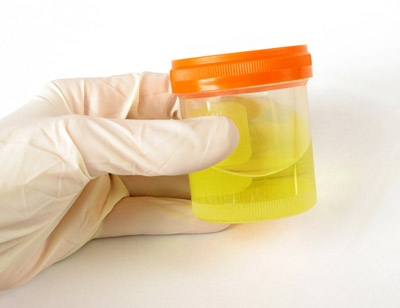
Key takeaways
How to make a urine analysis report: preparing the sample, physical characters such as volume, colour, odor, pH and specific gravity, and abnormal results.
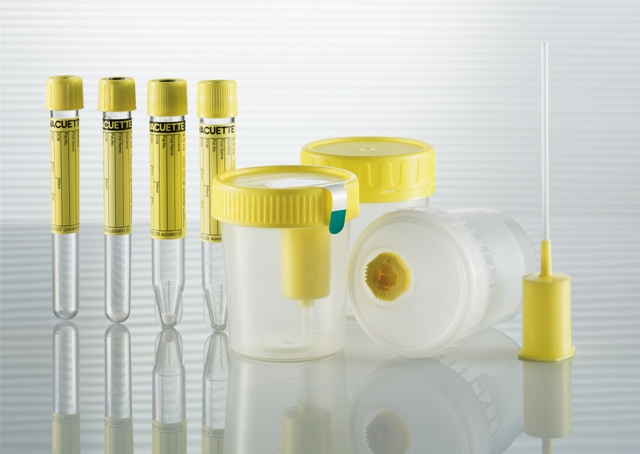
Doctors can learn a lot about patients from their urine,
Urine analysis help in detecting kidney diseases , diabetes , Bilharziasis , Ketosis , drug abuse, and many other disorders .
I – Preparing a Urine sample :
A- The most popular technique for getting some urine is the clean-catch method,
– The urethral opening is properly cleaned using swabs or pieces of cotton socked with betadine or benzalkonium hydrochloride , going in one direction from up to down and not the opposite .
– After the patient has cleansed the urethral opening , a small sterile container with a firm cap is used to collect the urine
– reject the 1st mls of urine and then start collecting it in the middle of the urination process .
Hint : the first urine voided is not collected because it will be contaminated with those microorganisms normally occurring in the lower portion of the urethra. Only the midstream portion is collected since it most likely will contain those microorganisms found in the urinary bladder.
B- Catheters are used In case of urinary retention , Three types of catheters are available :
– Hard catheter is used when the urethra is very narrow or has strictures.
– French catheter is a soft tube used to obtain a single specimen sample.
– Foley catheter is used If multiple urine samples are required over a prolonged period of time.
=================
II- Physical characters of Urine :
1- Volume :
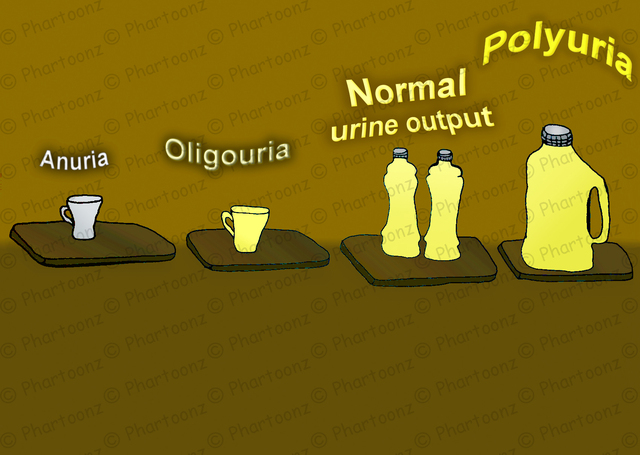
Normal urine output is about 1-2 litters per day
less than one litter daily of urine is called oligouria ( < 1L ) ,
more than 2 litters is called Polyuria ( > 2L ) ,
Having No urine output at all is known as Anuria
abnormal volume of urine can help in identifying some pathological conditions ,
e.g : Polyuria could be a symptom of Diabetes mellitus , renal diabetes or chronic renal disease while oligouria is recorded in case of excessive sweating , vomiting and diarrhea .
>> Urine volume varies for a day to another according to many factors that should be taken in consideration while reading a Urine analysis report :
A – Temperature :
– in summer ( high temperature ) , the perspiration and sweating rates increase and so the urine volume is decreased ↓
– in winter ( low temperatures ) , the perspiration and sweating rates are decreased so most of the excess water is excreted mainly in urine ( ↑ urine volume )
 B – Diet :
– food rich in protiens increases the excretion of urea , and since Urea is a solid will withdraw more water on it’s way out to dissolve in it to be excreted easily . ( ↑ urine volume )
– spicy food usually makes people drink more water , so more water is filtered through kidneys . ( ↑ urine volume )
-High fluid intake & Xanthene beverages  – as coffee and Tea – increase urine volume too ↑
 C – Drugs :
– Diuretics as Xanthine alkaloids increase the volume of urine
– Digitalis also increases the volume of urine , because it’s used in treatment of Congestive heart failure by increasing the Muscle tone of the heart and therefore enhances circulation and blood flow , so more blood passes through the kidneys and more water is filtered . ( ↑ urine volume )
– Anticholinergic drugs as Atropine decreases most of the body secretions including urine ( ↓ urine volume )
==========================
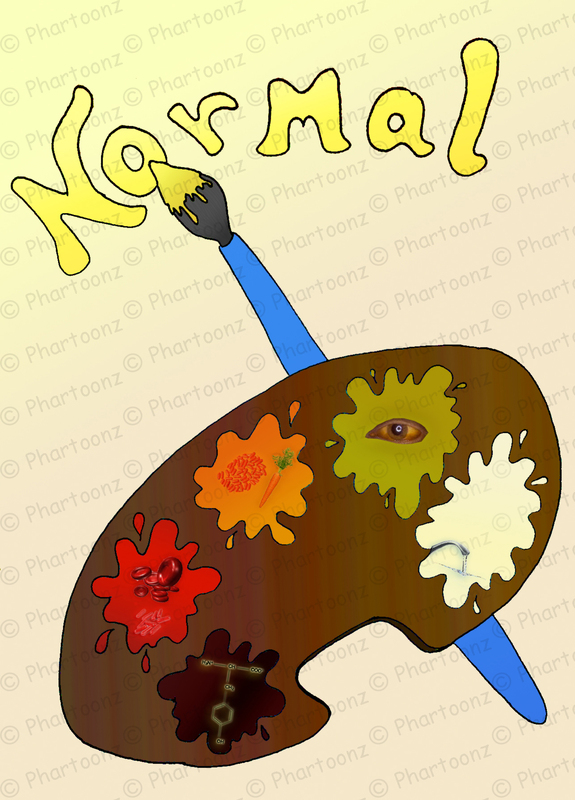
2 – Colour
Normal urine colour is pale to dark yellow , this yellow colour is due to the presence of 3 pigments in urine :

– Urobilin
– Urochrome
– Uroerythrin
———
Abnormal Urine Colours :
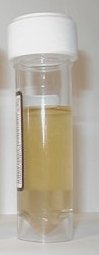
– Very faint pale yellow or colourless :
this is due to dilution of urine pigments with a large amount of water ( Polyuria ) , e.g : diabetes mellitus
–
—–
– yellowish green :
Due to excretion of bile in urine , e.g : Jaundice
—–
—-
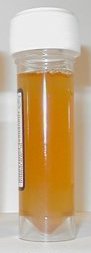
– orange :
because of eating carrots or taking some drugs as Phenazopyridine ( urinary
antiseptic )
—–
——
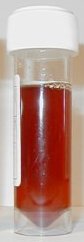
– red :
appears on taking some medications as Rifampicin ( TB treatment ) , or due to presence of blood in urine , e.g : Bilharziasis
Hint : if the patient is a female it could be just menstrual blood .
———–
———–
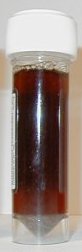
– black :
most common reason is Alkaptonuria , which is a disorder in Tyrosine metabolism where homogenestic acid is accumulated and excreted in urine and upon oxidation it gives Urine that characteristic black colour .
====================================
………
3 – Odor :
Fresh Normal urine has a faint aromatic odor due to presence of volatile organic acids .
After a while , Bacteria starts working on Urea found in urine using Urease enzyme , so the urea is broken down to carbon dioxide & ammonia ( CO2 + NH3 ) So the urine has ammonia odor .
abnormal odors of urine :
– Ripe apple like odor : due to presence of acetone in urine , e.g : ketosis , diabetes mellitus .
– Very bad odor : due to presence of Pus cells and epithelial cells in urine , e.g : Bilharziasis , renal inflammation , Pyuria .
=======================
4- Aspect :
Normal urine is Clear
turbid or cloudy urine indicates presence of Pus cells , crystals , epithelial cells or RBCs
Hint : Milky appearance in a male’s urine could be due to presence of sperms .
=========================
5- Sediment :
Fresh normal urine contains no sediment ,
if sediment is present it may be :
– Organized : as Pus cells or RBCs
– Unorganized : as Phosphate & Oxalate crystals ( examined under the microscope )
Hint : ” aspect ” deals with the consistency and appearance of the whole urine sample ,
while ” sediment ” means the deposited substances and periceptate that could be found in the bottom of the urine sample .
=====================================
6- Urine PH :
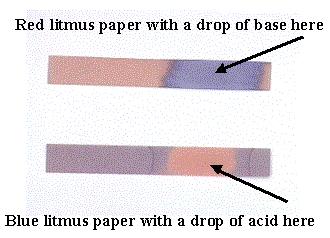
Fresh Normal urine is slightly acidic ( PH = 5.7 – 6.8 )
thats due to presence of Na & K salts of mono & Di basic phosphoric acid .
– after a while , as we said in the odor part , bacteria will work on urea generating ammoina which is basic in nature so the urine becomes alkaline .
abnormal Urine PH :
– acidic urine indicates respiratory or metabolic acidosis
– alkaline urine indicates respiratory or metabolic alkalosis
– Diet also affects the Urine PH and should be taken in consideration while reading a Urine analysis report ,
e.g : vegetables and fruits containing large amounts of sodium citrate makes the urine more alkaline , as the citrate enters Krebs cycle while Sodium (Na+) is excreted in urine as basic Sodium bicarbonate ( NaHCO3 ) .
Hints :
– respiratory acidosis means that the exhalation of CO2 is decreased ( Hypo-ventilation ) so instead of going out of the body, CO2 is transformed into Carbonic acid ( H2CO3 ) making Urine more acidic ,
in respiratory alkalosis , the opposite occurs … CO2 exhalation is much increased ( Hyper-ventilation ) and CO2 & carbonic acid levels become below normal , so the urine becomes more alkaline .
– metabolic acidosis means that there is a disorder in a certain metabolic pathway leading to abnormal increase of acidic products ,
while metabolic alkalosis is due to a disorder in a certain metabolic pathway leading to abnormal increase in basic products .
=====================
7- specific gravity :
– Normal urine specific gravity ranges between 1015 – 1025
– Higher specific gravity is due to excess solids in urine , e.g : Glucose in urine as diabetes mellitus , Urea in case of protein rich diet .
– Lower specific gravity indicates more fluild and less solids in urine , e.g : Diabetes insipidus ( deficiency of Anti diuretic hormone “ADH” ) leading to dilution of urine .
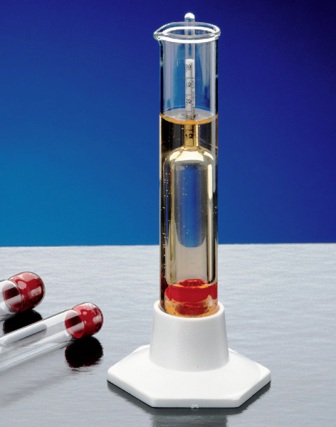
Hint :
specific gravity is measured by urinometer or lactometer , these instruments are commonly programmed on a temperature 20°C
each 3°C increase in temperature increases specific gravity by 1 unit
so , to get an acurrate reading when the urine temperature is not 20 , use the following equation :
Accurate reading = Instrument reading + [ ( T – 20 ) ÷ 3 ] , where T = urine temperature .
==============================
III – Abnormal Constituents in Urine :
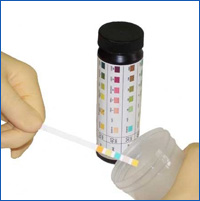
1- Albumin :
– indicates albuminuria , liver & kidney diseases and sometimes heart diseases also .
2- Glucose :
– indicates Glucosuria , Diabetes mellitus , excessive sweet in diet , renal diabetes .
3 – Blood :
– indicates Haematuria , Bilharziasis
4- Ketone bodies :
– Keonuria ,
– break down of fat to be used as a source of energy , leading to increased Acetyl CO A levels that is condensated into ketone bodies , e.g : Low Carbohydrate diet , starvation , excessive fat intake , Diabetes mellitus
Hint : most common ketone bodies are : acetone , acetoacetic acid & B-hydroxy butyric acid .
5- Bile salts & Bile pigments
– jaundice
6- Indican :
– indicates sever constipation , gastric cancer , gastritis or gastric obstruction .
these consituents and more are tested easily using special Urine test strips ,
here is a very good tutorial that explains it all 😉 :
part 1 :
===========
part 2 :
============
part 3 :
=========
Mmmm … using Yellow color a lot reminded me of something !
↓
↓

Say Hello to Mr. Happy , my favourite rubber ball of all the ones sold in our Pharmacy :happy:
we play together all the time when i’m working there 🙂
———-
References :
– Graff’s Textbook of Routine of Urinalysis and Body Fluids
http://www.ehow.com/how_4790922_urine-analysis.html
Tagged
About the author
Keep reading

How to Give an insulin Injection
Where is insulin injected ? Insulin is injected subcutaneously – into the fat layer just under the skin – If the syringe needle is injected too deep and reached the muscle, the insulin will be absorbed too fast as all the administered dose will move Quickly into the blood stream . Common sites…
Oct 24, 2010

Insulin Comparison Chart
Insulin Name When does it start working? (onset) When will the effect be the greatest? (peak) How long will it lower blood glucose? (duration) Notes for Use Cost estimate Rapid Acting Lispro (HumalogTM) <15 minutes 0.5-3 hours* 3-5 hours If mixing with NPH, rapid acting insulin should be drawn into syringe first. Mixture should be…
Jul 16, 2017
How to remember Vancomycin side effects – mnemonics
How to remember Vancomycin side effects ? Vancomycin is an anti-infective agent covering gm+v infections including MRSA. It is known as the gold standard for treating MRSA infections. Vancomycin is popular for its nephrotoxicity and ototoxicity along with “Red Man Syndrome”. How to remember the side effects of Vancomycin? NOT RED Although it is RED!…
May 9, 2017
what does insulin do to the body ? [Video]
When you hear the word insulin you may think of a drug taken by people who have diabetes either type 1 or type 2. Yes this is true, but what you may not know that insulin is already one of hormones secreted by your body. Insulin is important to the body, insulin allows the…
Dec 25, 2015
8 comments
From the original article · comments are closed
Mohamed
Thank you for helpful article.
BoNbOoNa
Welcome 🙂
Abd Elrhman
Great work 🙂 keep it up Hello Mr.Happy 😊
Tana
Hi there 🙂 Is it OK if I kinda off topic? I’m trying to read the website on my new Macbook but it doesn’t show properly, any solutions? Should I try to find an update for my software or something? Thanks! Tana x 🙂
BoNbOoNa
thanks 🙂
BoNbOoNa
i wish i could help but i dont know much about ” macbook ” i hope that problem is fixed soon , welcome any time Tana 🙂
Mahmoud
i didbt readthe topic till now but im sure it’s verywonderfull topic …… i had acopy of the topic on my pc for reading it as the net is aproblem ….thank u Bonbona :biggrin:
BoNbOoNa
always Welcome .. thank you 🙂