
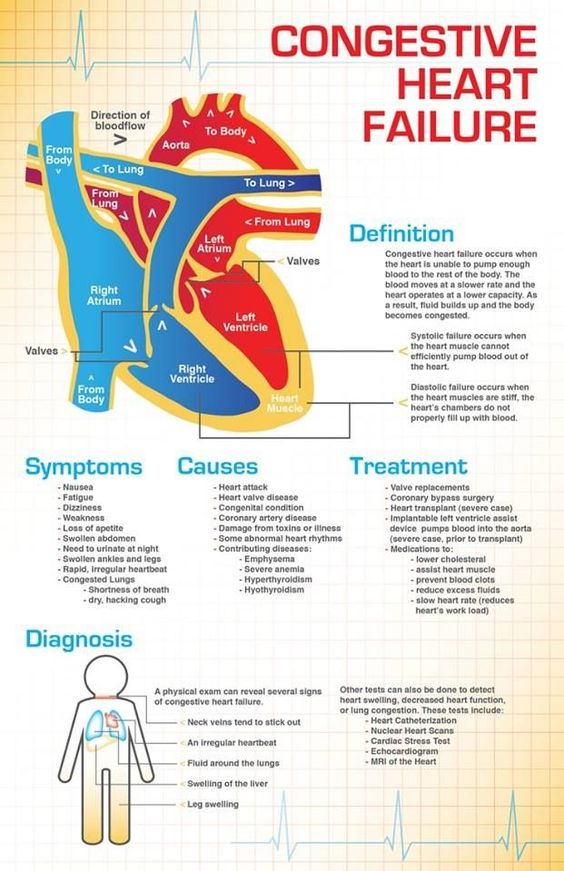
Congestive Heart Failure infographic
By Phartoonz
1 min read

What is Congestive Heart Failure (CHF)?
Congestive heart failure is a combined right and left heart failure, producing both pulmonary congestion and peripheral edema.
Causes of heart failure include:
- hypertension
- valvular disease
- cardiomyopathy
- coronary heart disease
The low cardiac output in heart failure results in increased sympathetic nervous activity, which stimulates the rate and force of the heart beat and maintains the blood pressure by increasing the vascular resistance. In the failing heart, the resulting increase in the resistance against which the heart has to pump (after-load) further depresses cardiac output.
Reduced renal blood flow results in renin secretion and increased plasma angiotensin and aldosterone levels. Sodium and water retention increase the blood volume, increasing the central venous pressure (pre-load) and the likelihood of edema formation.
These compensatory changes at first help to maintain cardiac output but, in the longer term, lead to changes (e.g. abnormal ventricu- lar dilatation) that increase morbidity and mortality.
Keep reading

Congestive Heart Failure – Animation video
Congestive Heart Failure video illustrating the steps of the heart when it becomes congested and cannot pump enough blood to the body. Video by BioDigital Inc.
Sep 14, 2016

Diseases of vitamins deficiency summarized
Diseases of vitamins deficiency It is very important to call the disease name as long as you have been asked about a vitamin deficiency. This is a common and repeated question in pharmacy examinations. For a quick comprehensive review on vitamins, click here. Please look at the following table: Vitamin Chemical Name If deficient causes…
May 20, 2017

Deep Vein Thrombosis – DVT explained by video
Venous thromboembolic disease represents a spectrum of conditions that includes deep vein thrombosis (DVT) and pulmonary embolism (PE). Deep venous thrombosis (DVT) A blood clot in the deep venous system, a network of large veins with extensive branching that covers the whole body. What are the Symptoms and Signs of a DVT? Pain and swelling…
May 20, 2017
Heart Attack | Animated Video
What Is Heart Attack? When blood doesn’t reach to your heart, your heart muscle doesn’t get the oxygen it needs. Without oxygen, its cells can be damaged or die (Ischemia). If this Ischemia has not been treated, part of the heart muscle will eventually become permanently damaged (Myocardial Infarction). The key to recovery is to…
Jan 2, 2017